Process for Project 2

Initial Idea/Assignment

The assignment was to create a lamp using the woodshop tools.  Market research was provided.
The inspiration for the shape came from a brick wall. The idea was to create something that would create a wall of light with multiple light sources instead of one focal light. It should also be movable and have an element of customization.

The initial idea was to make a piece with ten columns of 10 units each which would be 60" tall and 42" long.  This would function as a light screen on a floor lamp depending on the configuration.  It quickly became clear that this was not going to be possible in the time available so we scaled it down to a desk lamp size. This initial drawing also shows an initial idea about wiring that was revised after the test piece.

 Test Piece


Initial test pieces for individual unit scale
Landed on a fairly traditional subway tile 6" long to 3" high ratio with a 2" depth.  This gave it a pleasing ratio with enough room to house the lights without being too bulky.


I initially tried to use pre-strung LED lights but did not find any with the spacing I required.  I used LED's because the lights were enclosed and I did not want heat to be a problem.  After doing some online research I purchased LED light tape with double the lights per inch of the typical light tape to maximize light output.  I also found the electrical cord, transformer and dimmer online.  After watching some videos I soldered together my own custom light strips.

I sourced wood from three different places and ended up going with 10/4 poplar because it was locally available and inexpensive from Total Fabrications.  They gave me a piece to test with and also recommended gel stain to obtain even coverage between end grain and edge grain.  I did try some oil based stain on the test pieces and was not happy with the coverage or dry time.  

Test pieces. The conclusion of the test pieces was that the initial acrylic was too clear,  the stain too dark, bevelled edges were beneficial as they cut down on the blocky feeling of the units and the units should be all one color to enhance the cohesiveness of the pieces instead of stained and unfinished contrasting pieces. I did come up with a feasible way of routing the wiring through vinyl tubing, but it was not sturdy enough so alternating aluminum tubing was added to the final plan.
Working with one of my teammates, Hongyi, on Rhino to show the scale and rotation.  


Working out the scale of overall the piece in wood and cardboard as well as computer models. I decided it would be 18" high by 26" at it's longest

Final Piece

I created the initial order of operations before making the test pieces.  This is the final revised order of operations as well as a bill of materials and an assembly diagram.  The assembly diagram shows the final wiring diagram and was a crucial visual for keeping all the different block configurations clear to everyone through production and assembly.


We cleaned the 10/4 poplar to 2" x 3", routed out 1/2" by 1/2" channels in each corner and cut 36 two inch blocks.


 We routed out 1/8" channels for the acrylic windows and drilled the holes for the wire and tubing connections following the order of operations
 I soldered together three sets of 6 LED light strips with 6" wire in between and a 24" long piece of wire at the end to help us thread them through later

We used a gel stain in a slightly red toned cedar finish to counteract the greenish hue of the poplar.  My other teammate, Wanshan, did the initial staining of the insides of the units.
 After unit assembly, routing out the bevelled corners and sanding to 400 grit, they were ready for final staining.
 After they were stained and waxed we wired together three stacks of six alternating units with vinyl tubing connections, if I had this to do again I would have used aluminum here as well.
 Then we ran the long ends of the wire through connecting aluminum tubing and soldered the three sections together.  


 Once all the lights were working we could insert the final pieces of laser cut white acrylic and glue in the last wood corner piece.  
 We used a clear acrylic rod with laser cut ring stoppers on the top to connect the ends when it is in a continuous shape.

The end result fits nicely on a desk or end table in a variety of configurations and can be dimmed from a task light to more of a mood light.


DIY Survey Results

Received 14 responses to the previous survey about the attachment to products formed by assembling them your self.  Although this is not a huge sample size I think I  can safely say that assembly does not play a major factor in a consumer's attachment to a product.  In fact, they are slightly less likely to purchase something that requires assembly.

Factors that are more likely to influence attachment to a product are functionality and/or having made something from scratch yourself followed by someone else having made it for you, purchase price, and finally having had to assemble it.  This confirms my original suspicion that people like IKEA because it is cheap and easy to move while providing the necessary function. It is possible my questions were somewhat leading as it was my first survey.

4 people did say they were more likely to keep something they had had to put together and 3 people thought their effort to assemble it increased their feelings of attachment.  A question that is hard to know the answer to since it asks you to imagine a negative (how you would feel if you hadn't assembled it).

I have been giving this some thought and I think the ability to customize easily (complicated custom functions half of the buyers probably never use) or personalize a piece in some way is probably much more valuable to product attachment and brand loyalty.

I know that one of the first things you do when you buy an Apple product is give it a name and most of my things are named in the possessive (Amanda's iPod, etc.)  Does it make me more likely to overlook operational flaws and buy other Apple products?  Possibly. Logically I think it more about the huge monetary investment and the products' interconnectedness, but who knows how much of an effect naming something has subconsciously.

This has been on my mind because modularity and multi functional aspects have always been important to me and have figured prominently in the first two projects I've produced at SCAD.  It is also a concept I explored in a limited way in my designs for Ed Levin, Inc. (it is difficult to make rings and earrings modular) but something that was of supreme importance in my kitchen and bath designs.  Even the largest space likely needs to be multi functional or modular in a kitchen and also baths.  This is why people love pull out pieces, adjustable pieces and rolling islands.

Even if you set something one way and then never change it again at least you had the option to set it up the way you wanted and that works best for you.  Obviously not applicable to all product lines, but something to think about.

Project 2

     This was the second project for IDUS 501.  The assignment was to create a light fixture using the machines we had learned over the quarter in the wood shop.  There were no constraints as to what the light could look like. We could also use the laser cutter, CNC and 3D printing tools available.  I mostly stuck to the shop tools but did use the laser cutter for the acrylic pieces.
     The inspiration for this piece was a picture of a brick wall from this blog so it is serving its purpose.  The idea was to make an evenly lit piece the could be configured in a variety of different ways depending on the user's preference.  The light is dimmable as well to provide a custom light level. The process was complicated but with a lot of front end work it was a successful outcome.  And now I have the new desk lamp I've been needing.


Added connection through DIY?

I was listening to a podcast recently about IKEA hacks from 99% Invisible.  They briefly mentioned that one of the reasons IKEA furniture is so popular and you drag it around for so long is because you feel a sense of accomplishment and ownership once you put it together.  This dovetails somewhat with a couple of articles I've read that postulate that people who are in field in which they actually produce some product or create tangible things are more satisfied others.

Does this mean that we should deliberately design products with some assembly required?  I know I've held on to some junky stuff longer than reasonable because I assembled it from trash myself.  But I'm not sure screwing together my dining room table and chairs really made me feel any more attached to them.  Actually it made me notice the low quality of the materials involved more than anything else.  But the simple plug and play of some electronics does leave me feeling a little dissatisfied as well.  So I'm not sure how I feel about this premise.  It would be interesting survey material to see what others think.

Take survey here

Top Renovation Challenges

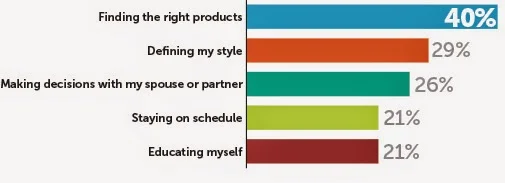
This chart shows the top renovation challenges as reported by US homeowners on Houzz.  

See the original full graphic 

here

.   Finding the right products is first by a 11% margin.  Followed by 'defining my style'.  There is probably a relationship between these two as it is easier to find the right products once you have defined a look or style.  

The main question this graph brought up in my mind is are people having trouble finding the right products because the selection is limited or because the selection is too broad.  In other words, are the right products not being made or are so many products out there that consumers become confused and unable to make a choice?  If it is the former there is a large professional opportunity for me, if the latter is true it also presents an opportunity to make products that are obvious better and the easy choice.  

It has also been my experience that there is the third possibility that the 'right' products are easy to find but not in the 'right' price point.  Most renovation dreams are possible for a price.  So really the challenge for homeowners is more likely finding the right product in their budget.

Project one

My first group project.  The challenge was to make a desk that can fit in student workspaces out of foam core.  We wanted something that was mobile and had storage but most of all was customizable.  This allow the user or users to work sitting or standing in multiple configurations.  It could be in the middle of a room, against a wall or in a corner.  The storage unit is on casters and the whole thing is fairly simple to break down and move, if it's not made with tape and hot glue.  In the end the would be made of extruded and bent metal and wood.  The top piece is a light and the drafting boards would be clear acrylic so they could double as light tables.


Is technologizing everything the future?

Magic in the Mundane

Do these things provide a valuable function beyond the cool factor?  The cool factor is clearly enough for some people, but like the $50+ egg minder that told me how many eggs I had left and which ones were oldest, some things go too far.
I'm clearly not an early adopter of anything.  If it doesn't provide an obvious and relatively dramatic improvement to my life I'm not paying extra for it.  Of course, sometimes it's hard to know how much something will improve your life until you have it.  Didn't think I'd use the iPad as much as I do.  Still not entirely convinced that the convenience of the iPhone is worth the occasional panic of making sure I didn't lose/drop/damage it.
I guess I'm also parts of the oughts obsessed with convergence.  I like how many functions I get out of the smartphone.  (I was actually surprised the other day when it rang and I used it to talk to someone.  I so rarely use it that way I genuinely forgot it had a phone function as well as text.)  I also like convergence because it means I don't have to buy a hundred things that do one thing,  one thing that does a hundred things is a better value in my mind.
The private/public data mining issue doesn't bother me much.  I'm not doing anything super secret or objectionable in general.  I ignore the adds, throw away the junk mail and delete the spam.  I suspect my google search history is pretty confusing to the algorithms anyway since I'm most often searching for things that other people have asked me about (family, professors, clients).  Amazon thinks I have kids and like baseball because I really only use it to buy presents for other people.